Play Spider Solitaire Online Free
Two-suit Spider is the version most people know from Windows: spades and hearts, two decks, ten columns. The puzzle is building sequences you can still move later, and a careful player wins a good share of games. It is free here, with no download and no signup. Every game has a number you can share, Hint and Undo have no limit, and you can switch between 1 suit, 2 suits and 4 suits.
How to play Spider Solitaire
Spider uses two decks, 104 cards. Ten columns are dealt, six cards in the first four and five in the rest, with only the last card of each face up. The other fifty cards sit in the stock at the top left. You are building eight complete sequences from King down to Ace in one suit. Each finished sequence leaves the table, and the game ends when all eight are gone.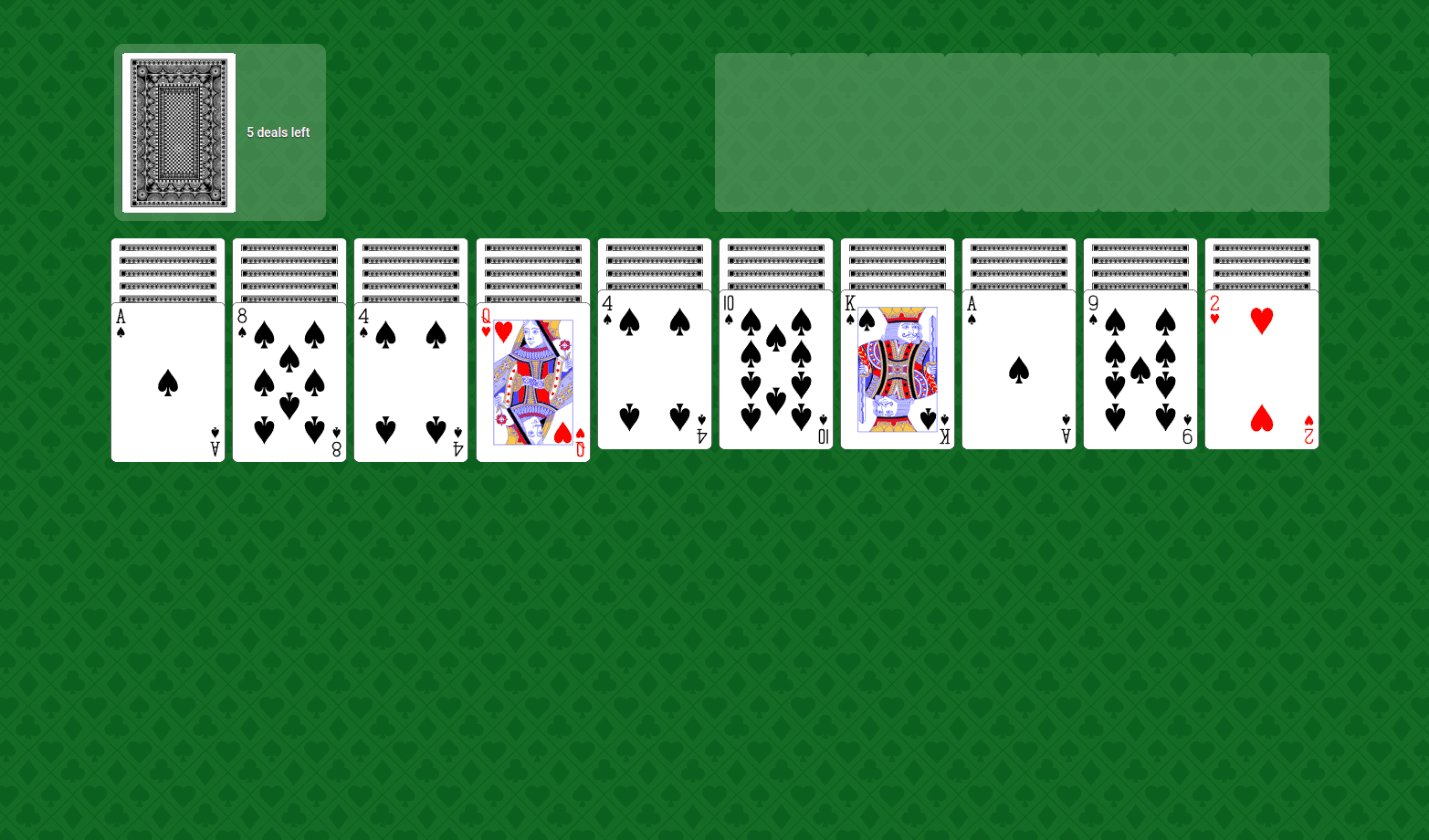
- Building: any card may be placed on a card one rank higher, whatever the suit. A 9 of hearts goes on a 10 of spades.
- Moving several cards: a group moves together only when it is one suit in descending order. A mixed stack has to be taken apart one card at a time.
- Empty columns: any card or sequence can go into one. They are the most useful thing on the table, so don't fill them carelessly.
- Dealing: click the stock to put one new card on every column. As in the original, you cannot deal while a column is empty.
- Finished sequences: a King-to-Ace sequence in one suit is removed the moment it is complete.
Hint outlines the cards to move and draws an arrow to where they go. If there is no move left at all, the game tells you, and Undo goes back as far as you like.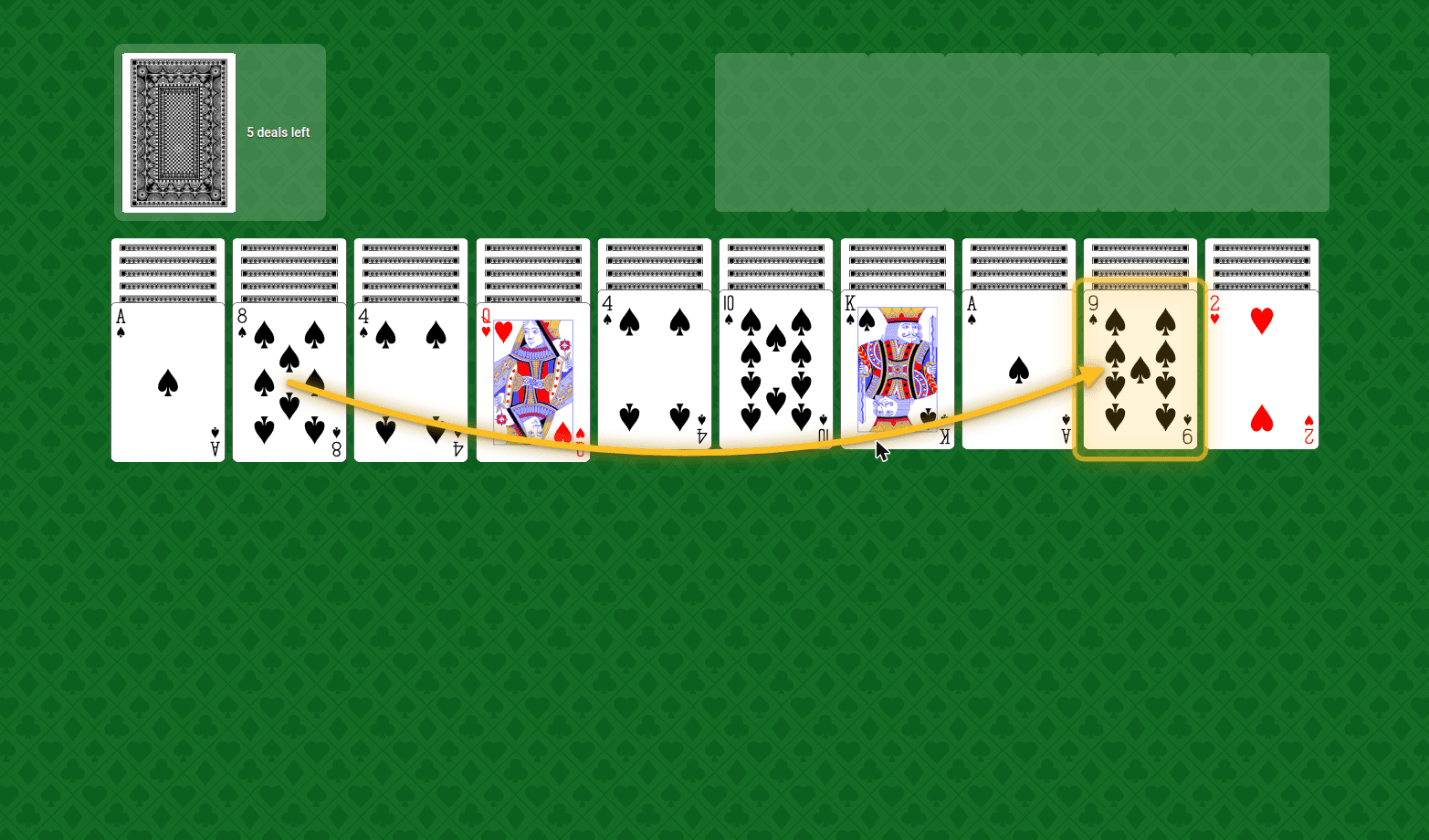
Spider strategy
Empty a column as early as you can and keep it empty as long as you can. It is the only place a King can start a sequence and the only way to re-sort a mixed pile. Build in one suit whenever you have the choice, even if an off-suit move looks tempting, because a mixed pile is stuck until you take it apart. Turn over face-down cards before you deal, since every deal buries ten more. And don't deal while you still have a useful move. The stock is for when you are out of options.
Where Spider comes from
Spider turns up in card game books from the 1940s. The name comes from the eight foundations, one for each leg. Most people met it on a computer: Microsoft included it in Windows ME in 2000 and Windows XP in 2001, with the same three difficulty levels you get here. Our deals are numbered, and the number in the side panel brings back the exact layout for anyone you send it to.
For a shorter game, Klondike Solitaire uses one deck and FreeCell has every card face up. The daily deal is the same for everyone today.