Klondike Solitaire
Klondike is a one-player card game for a single 52-card deck. You sort the whole deck into four piles, one per suit, each built from Ace up to King. The game above is standard Klondike with both draw modes. This page covers where the game comes from, how the deal works and how often a deal can be won.
A short history
People played Klondike with real cards long before computers. Most people learned it from Microsoft Solitaire, which shipped with Windows 3.0 in 1990. Wes Cherry wrote that version while he was an intern at Microsoft, and Susan Kare designed the card deck. Solitaire stayed in every version of Windows after that. Windows 8 replaced it with the Microsoft Solitaire Collection, which also includes Spider, FreeCell, Pyramid and TriPeaks. In 2019 Microsoft Solitaire entered the World Video Game Hall of Fame. In Britain the same game is usually called Patience.
The deal
The cards are dealt into seven columns, called the tableau. Column one gets one card, column two gets two, and so on up to seven cards in column seven. That uses 28 cards. Only the top card of each column is face up. The other 24 cards go face down into the stock. Above the tableau are four empty spaces for the foundations.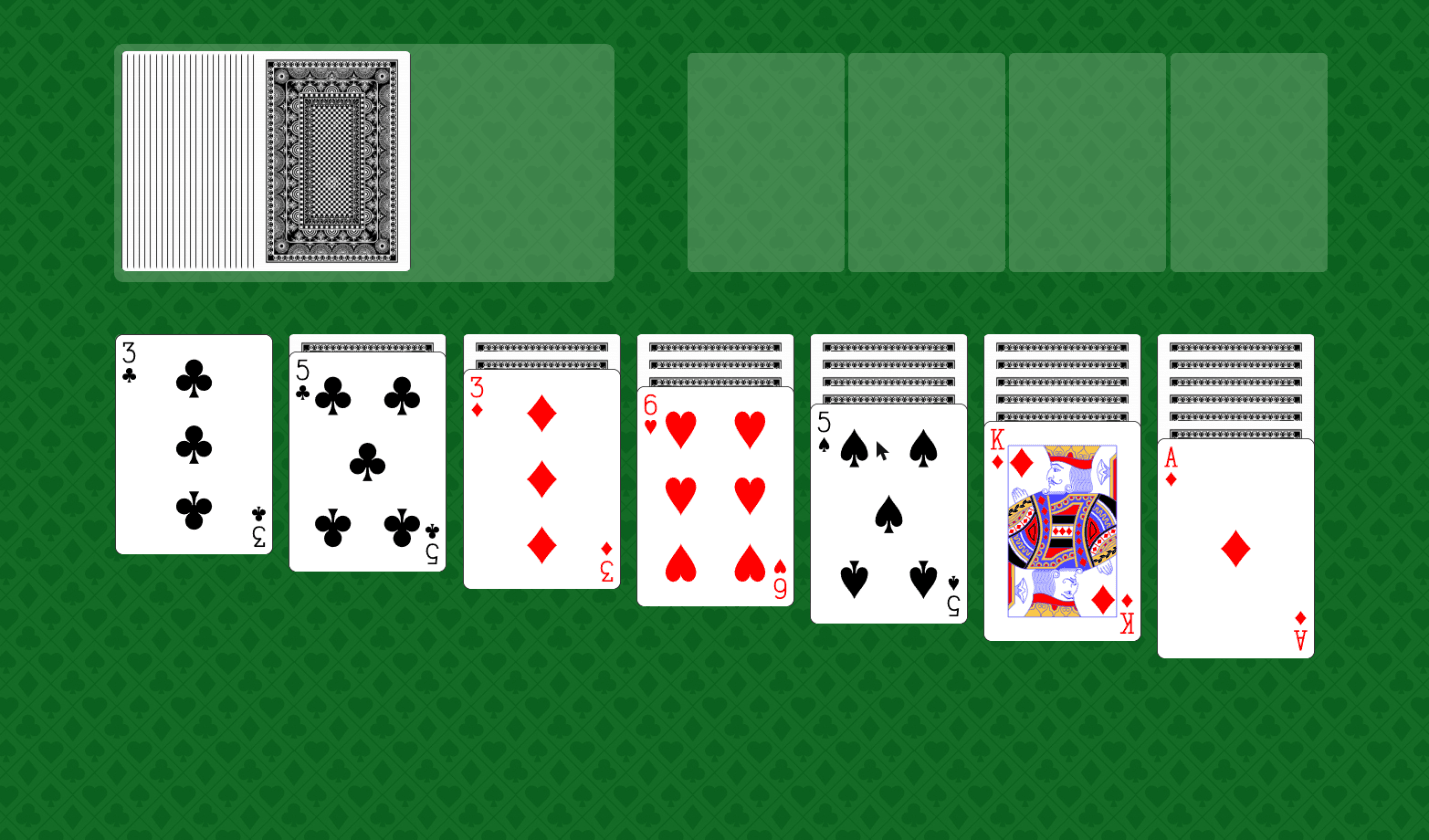
Columns are built down in rank with alternating colors, so a red 6 goes on a black 7. A face-up run moves as one unit. When a face-down card is left on top of a column, it is turned over. An empty column can take only a King or a run that starts with a King. The full list of legal moves is on the Solitaire rules page.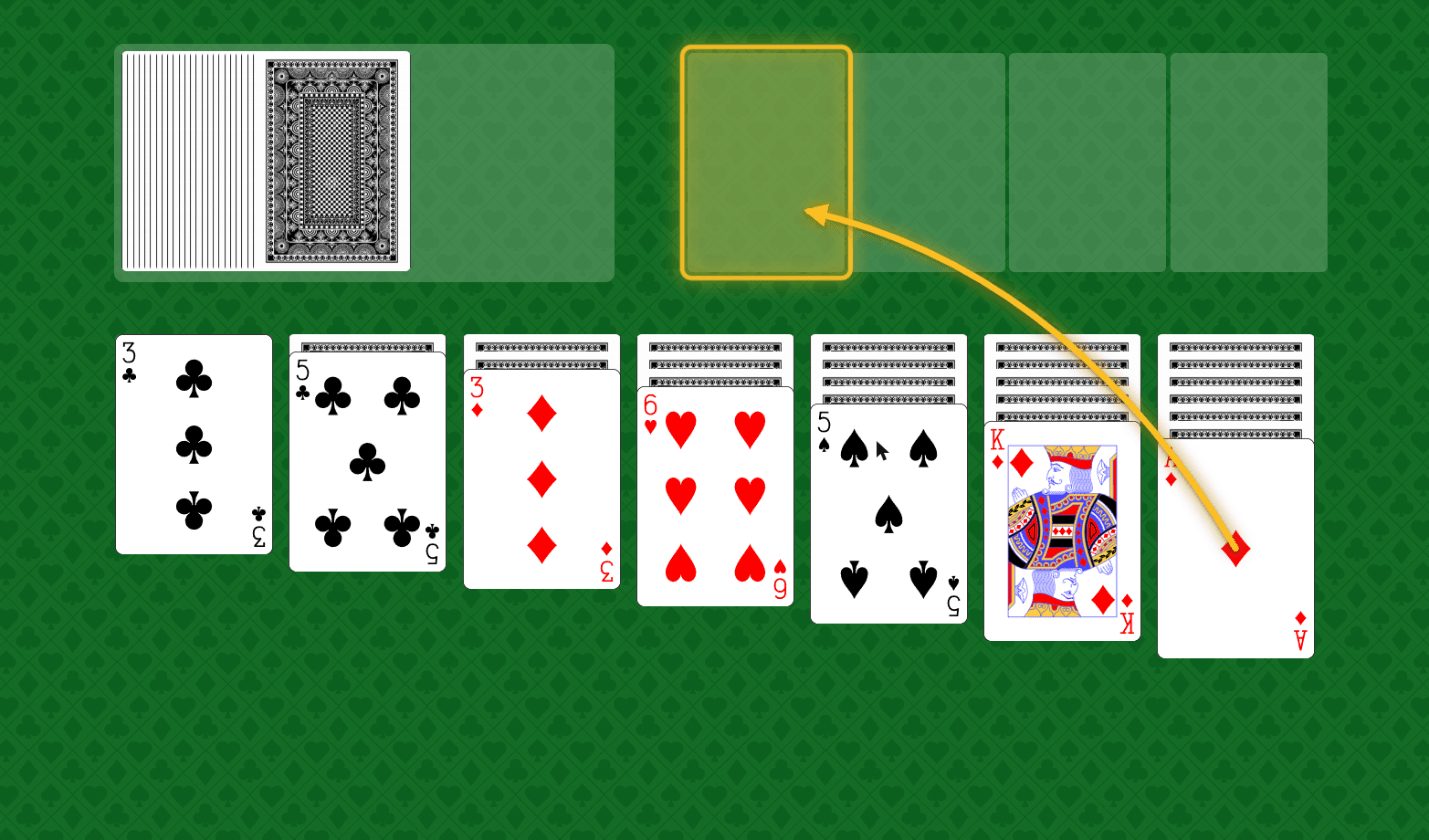
Turn 1 and Turn 3
The draw mode decides how the stock is used. In Turn 1 you turn one card at a time onto the waste pile, so every stock card is playable on every pass. In Turn 3 you turn three at a time and only the top one is playable. The cards under it come into play only after you use the card above them. Turn 3 is the harder mode, and it is the one this site starts in. Each mode has its own page with more detail and the game already set to that mode: Klondike Turn 1 and Klondike Turn 3.
How many deals can be won
If you could see every card, roughly 80% of Turn 1 deals could be won. You cannot see them. Twenty-one cards start face down in the tableau and the stock order is unknown, so some choices are guesses, and a guess can lose a deal that was winnable. That is why real win rates are much lower than 80%. Turn 3 lowers the figure further, because some stock cards are hard to reach. A few deals cannot be won at all, whatever you do. The strategy guide covers the habits that turn more of the winnable deals into wins.
More to read and play
- New to the game? How to play Solitaire walks through a first game move by move.
- The daily deal gives every player the same Klondike shuffle each day.
- FreeCell deals every card face up. Spider Solitaire uses two decks and ten columns.
- The home page has the same game and the site's features.